Indian Constitution - Cheat Sheet For Jkssb & SSC (JkssbPrep)
🏛️ Basic Facts
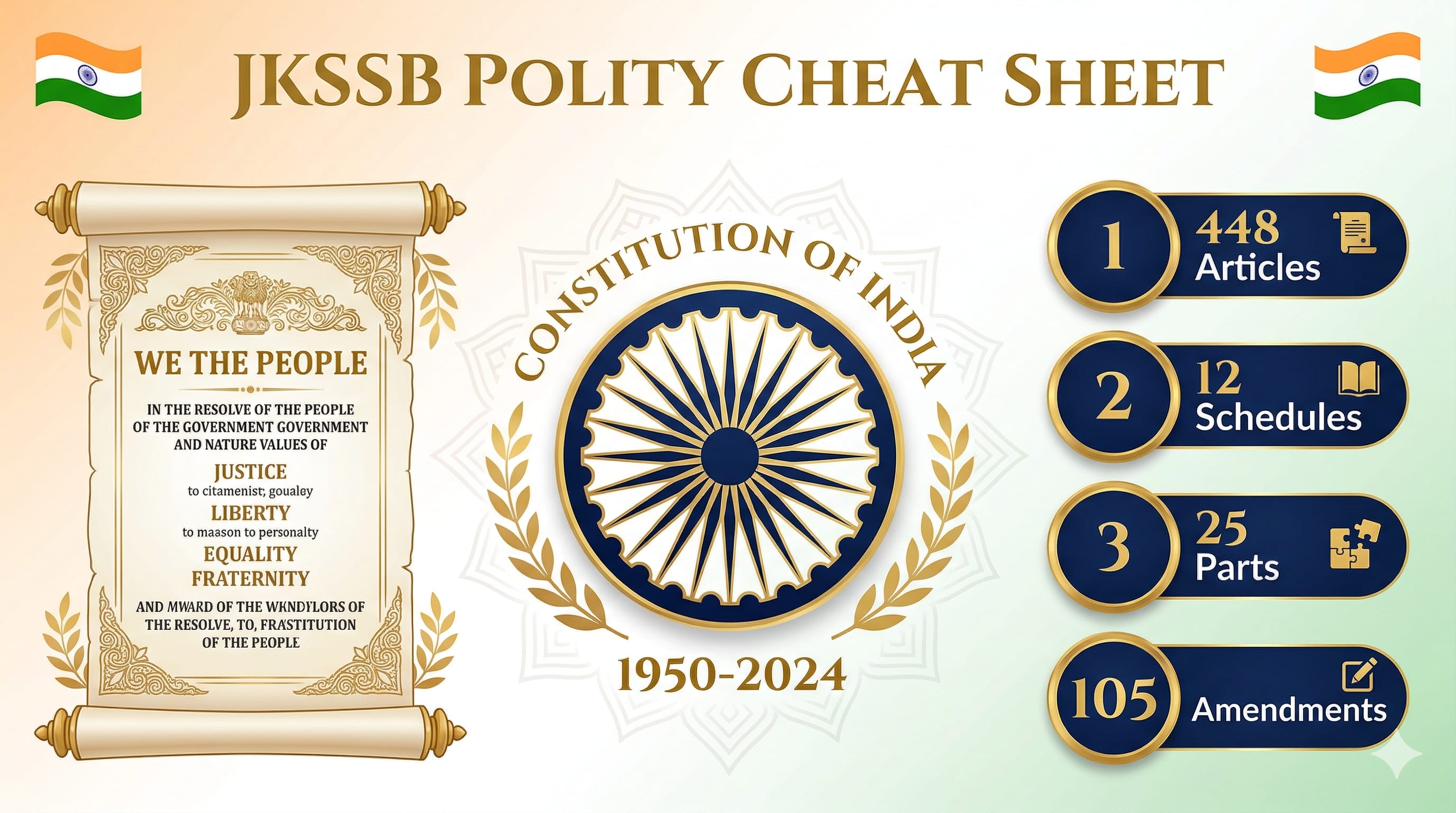
- Adopted: 26 November 1949
- Came into force: 26 January 1950
- Total Articles: 448 (originally 395)
- Total Parts: 25 (originally 22)
- Total Schedules: 12 (originally 8)
- Words: ~145,000 (longest written constitution)
- Drafting Committee Chairman: Dr. B.R. Ambedkar
- Drafting time: 2 years, 11 months, 18 days
📑 Important Parts
| Part | Articles | Subject |
|---|---|---|
| I | 1-4 | Union & its Territory |
| II | 5-11 | Citizenship |
| III | 12-35 | Fundamental Rights |
| IV | 36-51 | DPSP |
| IVA | 51A | Fundamental Duties |
| V | 52-151 | Union Government |
| VI | 152-237 | State Governments |
| VIII | 343-351 | Languages |
| IX | 324-329 | Elections |
| XIV | 308-323 | Services |
| XVI | 330-342 | Special Provisions |
| XX | 368 | Amendment Procedure |
🎯 Key Articles (Top 50 for JKSSB)
Union & Territory
- Art 1: India - Union of States
- Art 2: Admission of new states
- Art 3: Formation of new states
- Art 4: Laws for territorial changes
Citizenship
- Art 5-11: Citizenship provisions
Fundamental Rights (12-35)
- Art 14: Equality before law
- Art 15: Prohibition of discrimination
- Art 16: Equality in public employment
- Art 17: Abolition of untouchability
- Art 19: Six freedoms (originally 7)
- Speech & expression
- Assembly
- Association
- Movement
- Residence
- Profession
7. Property(deleted by 44th Amendment)
- Art 20: Protection in criminal cases
- Art 21: Right to life & personal liberty
- Art 21A: Right to education (6-14 years)
- Art 22: Protection against arrest
- Art 23: Prohibition of trafficking
- Art 24: Child labour prohibition
- Art 25-28: Right to religion
- Art 29-30: Cultural & educational rights
- Art 32: Constitutional remedies (Dr. Ambedkar called it "Heart & Soul")
DPSP (36-51)
- Art 39A: Free legal aid
- Art 40: Village Panchayats
- Art 41: Right to work
- Art 43A: Participation in management
- Art 44: Uniform Civil Code
- Art 45: Early childhood care (0-6 years)
- Art 48: Agriculture & animal husbandry
- Art 48A: Environment protection
- Art 51: International peace
Fundamental Duties (51A)
- 11 duties (originally 10, 11th added by 86th Amendment)
Union Executive
- Art 52: President of India
- Art 53: Executive power of Union
- Art 54: Election of President
- Art 61: Impeachment of President
- Art 63: Vice President
- Art 72: President's pardoning power
- Art 74: Council of Ministers
- Art 75: PM & Council of Ministers
- Art 76: Attorney General
- Art 78: PM's duties to President
Parliament
- Art 79: Constitution of Parliament
- Art 80: Composition of Rajya Sabha (max 250)
- Art 81: Composition of Lok Sabha (max 552)
- Art 83: Duration (5 years)
- Art 110: Money Bill
- Art 112: Annual Financial Statement (Budget)
- Art 123: Ordinance by President
Judiciary
- Art 124: Supreme Court establishment
- Art 126: Acting Chief Justice
- Art 129: SC as court of record
- Art 131: Original jurisdiction
- Art 132-136: Appellate jurisdiction
- Art 137: Review
- Art 141: Law declared by SC binding
- Art 143: Advisory jurisdiction
- Art 147: Interpretation of Constitution
- Art 148: CAG (Comptroller & Auditor General)
State Executive
- Art 153: Governor
- Art 154: Executive power of State
- Art 163: Council of Ministers
- Art 165: Advocate General
- Art 166: Conduct of government business
State Legislature
- Art 168: Constitution of Legislature
- Art 170: Composition of Assemblies
- Art 171: Legislative Councils
- Art 172: Duration (5 years)
- Art 200: Assent to Bills
- Art 201: Bills reserved for President
- Art 213: Ordinance by Governor
High Courts
- Art 214: High Courts
- Art 226: Writ jurisdiction
- Art 227: Superintendence over subordinate courts
J&K Special Provisions
- Art 370:
Special status(Abrogated 5 Aug 2019) - Art 371: Special provisions for other states
Elections
- Art 324: Election Commission
- Art 325: Universal adult suffrage
- Art 326: Adult suffrage (18+ years)
Amendment
- Art 368: Amendment procedure
Emergency
- Art 352: National Emergency
- Art 356: State Emergency (President's Rule)
- Art 360: Financial Emergency
Languages
- Art 343: Official language (Hindi in Devanagari)
- Art 344: Commission on official language
- Art 351: Development of Hindi
📊 Important Schedules
| Schedule | Subject | Articles |
|---|---|---|
| 1st | States & UTs | Art 1, 4 |
| 2nd | Emoluments (Salaries) | Art 59, 65, 75, 97, 125, 148, 158, 164, 186, 221 |
| 3rd | Forms of Oaths | Art 75, 84, 99, 124, 146, 173, 188 |
| 4th | Rajya Sabha seats allocation | Art 4, 80 |
| 5th | PESA - Scheduled Areas | Art 244 |
| 6th | Tribal areas (NE) | Art 244, 275 |
| 7th | Distribution of Powers | Art 246 |
| 8th | 22 Languages | Art 344, 351 |
| 9th | Land reforms & other laws | Art 31B |
| 10th | Anti-defection | Art 102, 191 |
| 11th | Panchayat powers (29 items) | Art 243G |
| 12th | Municipal powers (18 items) | Art 243W |
7th Schedule - Lists
Union List: 97 subjects (originally 97, now 100+)
- Defence, Foreign Affairs, Railways, Banking, Currency, etc.
State List: 66 subjects (originally 66)
- Police, Public Health, Agriculture, Irrigation, Land, etc.
Concurrent List: 47 subjects (originally 47, now 52)
- Education, Forest, Marriage, Adoption, Electricity, etc.
Residuary Powers: With Union (Art 248)
🔢 Constitutional Amendments (Important)
| Amendment | Year | Key Changes |
|---|---|---|
| 1st | 1951 | 9th Schedule added, restrictions on FR |
| 7th | 1956 | States reorganization |
| 24th | 1971 | Parliament can amend FR, President must give assent |
| 25th | 1971 | Right to property not a FR |
| 42nd | 1976 | Mini Constitution - Socialist, Secular, Integrity added; DPSP > FR; 10 FD added; Term extended to 6 years |
| 44th | 1978 | Right to property became legal right (Art 300A); Emergency provisions modified |
| 52nd | 1985 | Anti-defection Law (10th Schedule) |
| 61st | 1989 | Voting age reduced 21→18 |
| 73rd | 1992 | Panchayati Raj (Part IX, 11th Schedule) |
| 74th | 1992 | Municipalities (Part IXA, 12th Schedule) |
| 86th | 2002 | Education (6-14) as FR (Art 21A); FD for parents (51A-k) |
| 91st | 2003 | Defection - size of CoM limited |
| 97th | 2011 | Co-operative societies (Part IXB) |
| 101st | 2016 | GST |
| 102nd | 2018 | NCBC - National Commission for Backward Classes |
| 103rd | 2019 | 10% EWS reservation |
| 104th | 2020 | Extension of SC/ST reservation in LS & Assemblies |
| 105th | 2021 | Restore states' power to identify OBCs |
Total Amendments till date: 105+
🎓 Amendment Procedures
Type 1: Simple Majority
- Creation/abolition of Legislative Councils
- Citizenship
- Elections
- Salaries
Type 2: Special Majority (Art 368)
2/3 of present & voting + majority of total strength
- Most amendments
- Fundamental Rights
- DPSP
- All provisions not covered in Type 3
Type 3: Special Majority + State Ratification
½ states must ratify
- Election of President
- Extent of executive power (Union/State)
- Supreme Court & High Courts
- Distribution of legislative powers
- Art 368 itself
- Representation of states in Parliament
🏆 Important Concepts
Writs (Art 32 & 226)
- Habeas Corpus: Produce the body
- Mandamus: We command (to public official)
- Prohibition: Prevent lower court from exceeding jurisdiction
- Certiorari: To be certified (quash order of lower court)
- Quo Warranto: By what authority? (holding public office)
Parliamentary Privileges
- Freedom of speech
- Immunity from court proceedings
- Right to publish debates
- Right to exclude strangers
- Right to punish for contempt
Doctrines
- Doctrine of Pleasure: Art 310 (civil servants hold office during President's/Governor's pleasure)
- Doctrine of Pith & Substance: Determine which list a law belongs to
- Doctrine of Colorable Legislation: Legislature cannot do indirectly what it cannot do directly
- Doctrine of Eclipse: Pre-constitution laws inconsistent with FR are eclipsed, not dead
📈 Numerical Data
President
- Term: 5 years
- Re-election: Unlimited times
- Qualification: Age 35+, qualified for LS
- Electoral College value =
Parliament
- Lok Sabha: Max 552 (530 states + 20 UTs + 2 Anglo-Indians*)
- *Abolished by 104th Amendment
- Rajya Sabha: Max 250 (238 elected + 12 nominated)
- Quorum: 1/10 of total strength
- Money Bill: Only in Lok Sabha
- RS delay on Money Bill: 14 days
- RS delay on ordinary bill: 6 months
Supreme Court
- Judges: 1 CJI + 33 judges (originally 7)
- Retirement age: 65 years
- Minimum for quorum: 5 judges
High Court
- Retirement age: 62 years
CAG
- Term: 6 years or 65 years (whichever earlier)
Attorney General
- Term: At President's pleasure
- Qualification: Qualified to be SC judge
🗳️ Elections & Representation
Reservation in LS & Assemblies
- SC: In proportion to population
- ST: In proportion to population
- Duration: Extended till 2030 (104th Amendment)
Women Reservation
- 33% reservation: Passed in 2023, implementation pending
Voting Age
- Current: 18 years (61st Amendment, 1989)
- Original: 21 years
🌟 Sources of Indian Constitution
- Government of India Act 1935 - Federal scheme, Judiciary, Governors, Emergency, PSC
- British Constitution - Parliamentary system, Rule of law, Single citizenship
- US Constitution - Fundamental Rights, Judicial Review, Independence of Judiciary, Preamble
- Irish Constitution - DPSP, Nomination of RS members
- Australian Constitution - Concurrent list, Freedom of trade
- Canadian Constitution - Federation with strong center, Residuary powers
- Soviet Constitution - Fundamental Duties, Social, Economic & Political Justice
- French Constitution - Republic, Liberty, Equality, Fraternity
- German Constitution - Emergency provisions
- South African Constitution - Amendment procedure, Election of RS members
🎯 Quick Revision Points
Preamble Keywords
WE, THE PEOPLE OF INDIA
- SOVEREIGN
- SOCIALIST (42nd)
- SECULAR (42nd)
- DEMOCRATIC
- REPUBLIC
Objectives:
- JUSTICE (Social, Economic, Political)
- LIBERTY (Thought, Expression, Belief, Faith, Worship)
- EQUALITY (Status, Opportunity)
- FRATERNITY (Dignity of Individual, Unity & INTEGRITY*)
- *Integrity added by 42nd Amendment
Important Committees
- Drafting Committee: Dr. B.R. Ambedkar (Chairman)
- Union Powers Committee: Jawaharlal Nehru
- Provincial Constitution Committee: Sardar Patel
- Fundamental Rights Committee: Sardar Patel
- Union Constitution Committee: Jawaharlal Nehru
- States Committee: Jawaharlal Nehru
- Steering Committee: Dr. Rajendra Prasad
💡 Must Remember for JKSSB
✅ Part III - All FR articles (12-35) ✅ Part IV - Key DPSP (36-51) ✅ Part IVA - 11 Fundamental Duties (51A) ✅ 7th Schedule - 3 Lists ✅ 8th Schedule - 22 Languages (know first & last added) ✅ 10th Schedule - Anti-defection ✅ All writs with meanings ✅ Amendment types (Simple, Special, Special+Ratification) ✅ 42nd Amendment (Mini Constitution) ✅ 73rd & 74th Amendments (Panchayati Raj & Municipalities) ✅ Art 370 - J&K special status (abrogated) ✅ Emergency provisions (352, 356, 360)
📝 Formula & Numbers
President's Electoral College:
Quorum: of total members
Impeachment of President:
- Charge: of total members
- Investigation: of total members
Constitutional Amendment (Special Majority):
- of members present & voting
- Majority of total strength
All the best for JKSSB! 🎯🇮🇳